
If you have researched setting personal goals, you have likely encountered the claim that a Harvard Business School study showed writing down your goals makes you 10 times more likely to achieve them.
However, no such study exists.
In 2007, Dr. Gail Matthews set out to experimentally investigate the claim made by this myth. Her study showed that writing goals combined with public commitment and accountability significantly increase the likelihood of follow-through.
While my primary aim with One Year of Writing (OYW) is squarely to provide useful writing on leadership and technology, I also want it to be a public case study in building a writing habit and craft. So - armed with the knowledge from Matthews’ work - I decided to pursue my objective of posting weekly throughout 2026, by applying the suggestions in the study. Expect evidence-informed reflections, practical tools, and honest progress reports (including failures).
This brings us to what the study measured and how it affects my project.
The Study#
Matthews’ work went beyond comparing performance in written vs. unwritten goals. It found that participants were most likely to achieve their goals when they did all of the following:
Wrote their goals down explicitly.
Committed to specific action steps to reach those goals.
Submitted regular progress reports on how those actions were going.
Named a supportive friend to act as an accountability partner.
While still a far cry from the 10x increase from the urban legend, experimental data showed a respectable 78% improvement over the baseline (just setting goals in your mind).
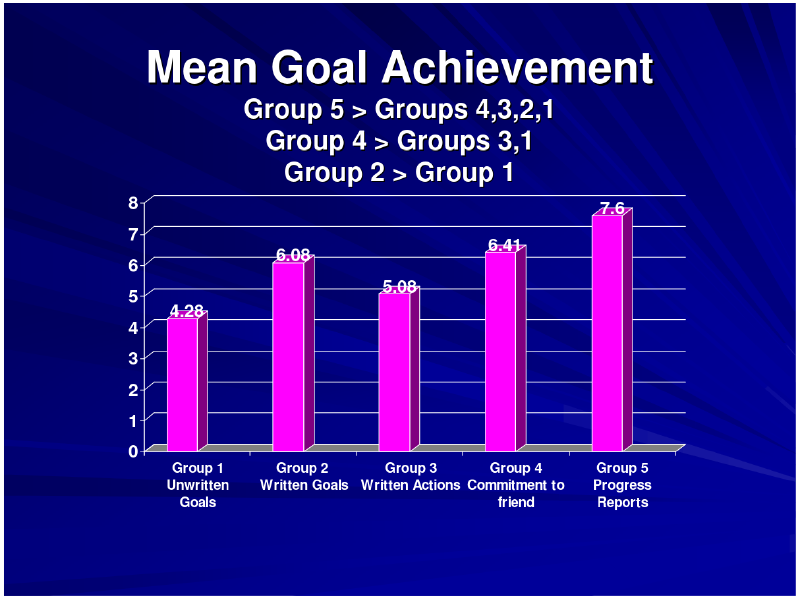
In more general terms, the study highlighted three core mechanisms that make achieving an objective more likely: written goals, public commitment, and accountability.
The remainder of this post is me doing those three things.
Written Goals#
To understand how I structured my goals, it may be useful to read my previous post about explorers and scientists. If you are short on time, here’s the TL;DR: it’s better to mix organic learning (explorers) with deliberate research (scientists).

Though trained as a scientist, I’m a hopeless explorer at heart. I love new adventures and have often turned my life upside-down on a hunch or intuition.
It is with this mindset that I have started One Year of Writing. It is the appeal of an adventure, the lure of “going where no Mac has gone before”1 that got me started.
The Marco Polo in me expects that by writing regularly - among others - I will gain…
New knowledge from research. For me, writing helps solidify intuitions into mental models and clarify my thinking. I do this primarily by researching the topic and verifying if my ideas have been considered before and if so, how they have been challenged. I will track progress on this by noting - for each post - one piece of knowledge gained from the research.
New thoughts from readers’ feedback. Growing a readership is not a focus of mine, but I still count on a few people reading my writing and providing feedback. I can’t control the feedback I receive, but I will adjust my efforts in advertising OYW to collect at least 12 pieces of feedback by year’s end.
New meaning from remastering old thoughts. By remastering, I mean reprocessing past experiences through new frames of reference. For example, I might re-read a failed project with a leadership lens and discover lessons I missed the first time. To measure this, I will note down one “remastered insight” per post.
New people. On LinkedIn, interesting people occasionally reach out to me after reading something I wrote. I even met some IRL. Since I already keep a list of interesting people I randomly find, I’ll continue doing that.
Conversely, this is what Marie Curie’s voice in my head will focus on getting out of One Year of Writing:
A method to compose text iteratively. In observing my writing, I realise I do a lot of premature optimisation2 and take forever to get to a reasonable draft. Instead, I’d like to quickly get to a first draft and only then iterate over it progressively improving clarity, conciseness, memorability, and style. I intend to develop a proper method (with steps, rules, checkpoints…) and document it in a future post.
Speed. If premature optimisation wasn’t slowing me down enough, I am also a slow writer. It takes time for me to formulate my thoughts, and I often lose myself in my own thoughts. I expect the above method to help me write more quickly, and I’ll measure progress by tracking time spent on each post and calculating minutes (or seconds) per word.
Domain-specific knowledge. I am a man of many interests, but for OYW, I limited my focus to two themes: leadership and technology. I expect the first to be mostly dedicated to better structure my mental models around leadership (a field in which I have experience in), and the second to mostly revolve around AI safety (an entirely new topic for me). My hypothesis is that - with a bit of support from Madame Curie - I will be able to turn experiences and ideas into a cohesive lattice of mental models (i.e.: knowledge) for both themes. I am still unsure how to measure progress.
Perseverance & Discipline. To persevere despite failures and be disciplined despite distractions is always going to require effort. I hope OYW will act as a mental gym for the “discipline muscle”, building the habit of writing and thus reducing the amount of willpower needed over time. I’ll track this by rating the effort for each post on a 5-point scale (from “a lot of effort” to “delightfully easy”).
Public Commitment#
Besides the commitment to post weekly throughout 2026, I am also committing to the following:
Keep a record of the per-post metrics mentioned above.
Publish at least one mid-year progress update.
Publish a final post summarizing my achievements relative to the year’s goals.
Accountability#
Finally, accountability. Based on Matthews’ study recommendation, I picked a supportive friend to send my weekly report to. Those conversations will remain private, but I will likely include some insights in the “progress posts” mentioned earlier.